Standing at the mountain
I stare at its beauty
Looking at the ground
I find a small pebble
A small stone
A small rock
Picking it up
I again stare at the mountain
How does one small rock
Compare to this immense creation?
Then again
How do I compare
With the world?
I am small
Young
Where is my place
In the world?
So many things
I can do
So many things
I can achieve
But how does one
Do these great things?
I again stare at the mountain
Then at the pebble
They are very similar
Very little difference
I can do anything
No one is stopping me
My size makes no difference
Friday, November 20, 2009

Wednesday, November 18, 2009
A Two-Faced Man
When a hard-working man, like Wemmick, is given a job that requires a lot of seriousness, they may appear to others as a demanding individual. To Pip, his first impression of Wemmick is that he is cynical and has a dry personality, but when invited to his house for dinner, he observes that this orderly man has two different sides to his life. Work and business can cause a person to become someone they are not -- knowing that at any moment they could lose their job. When Wemmick returns to his home with Pip, he is allowed to reveal the true, merry and jovial man he is. He claims his house is a castle and although it is just a small gothic home he is proud and content with his living quarters and would not change it for the world. He tells Pip that he is own engineer, his own carpenter, his own plumber, and his own jack of all trades. This proves that Wemmick is satisfied with the way he lives and is fine with having to work hard to provide not only for himself, but his “aged parent.” In this chapter, Dickens is showing us that going to work every day can cause a person to have to hide their true identity until their work day is finished. “ Wemmick got dryer and harder as we went along, and his mouth tightened into a post office again.” (p. 209) In this quote, Pip is observing Wemmick’s personality changing as he leaves home and approaches work. This is the main concept Dickens is trying to get across; not that work is unhealthy, but that it can result in a person having to act like someone they are not.
Tuesday, November 17, 2009
Pip's Home Life
Pip is an innocent boy who has suffered so much at a young age; his mother and father have all passed away and not only has he lost his parents, but his five brothers, his companions, and his friends. Now, the only family he has left is his older sister who is merely twenty years older than him, raising him with her dark haired husband, Joe. Pip’s home life is very unique when compared to any of ours. His brother in law, acts like a younger brother, always wanting to be in the fun with Pip, and his older sister, like a wise old mother with a bit of a temper. Mrs. Joe Gargery is constantly stating that Pip should be grateful that she would bring him up as a child and that if she didn’t he would have joined the rest of their family in the churchyard a long time ago. She is fierce and forceful, but only wants Pip to behave under her circumstances. When Pip has to steal bread in order to return to the marshes and feed the convict, he feels guilty and because of this you know he has been brought up learning and following good morals.
Friday, October 16, 2009
The Good Earth Essay
This is the link to my summative essay on the novel The Good Earth. When I read this novel, I was constantly disturbed by the way women, including O-lan, were treated and so I created my thesis by combining my thoughts along with Pearl S Buck's on how poorly women were treated by Wang Lung and in general, China.
Tuesday, October 6, 2009
Thursday, October 1, 2009
Journal Entry - Mountain
The great hills of the earth
Tower over the horizon
I stare at this image
It captures my mind
And my soul
And I wonder how they got there
And how they were formed
And I wonder what's on top
And what's below
And I let my mind wander
To and fro
The clouds sweep over the very tip
Birds flying within the valleys
Up so high
I can no longer see them
Gone
Just like that
In an instant
Could happen to anyone
At any moment
For that is why I stare
At these large blocks of rock
I must not take advantage of life
For one day it could disappear
Gone
Just like that
In an instant
Tuesday, September 29, 2009
The Good Earth
In the novel The Good Earth by Pearl S. Buck, Wang-Lung is a young man who is beginning to figure out who he is by becoming more independent from his father and starting his own family. Wang's father has a brother who is very into himself; he is poor and is always asking for people to give him money and other goods. When Wang's uncle approaches him one day while he is working in the fields he asks Wang if he can "support" his family. Lung has worked very hard to earn his silver and although he spent hours of labor earning his riches he is generous and displays a gift upon his uncle. A man who is a beggar is never a good man; they may need money, but they should have to work hard like the others. It is not bad to ask a family member for support in times of need, but the way Wang Lung's uncle approached him was wrong and unacceptable.
When Wang Lung decides to take his family south due to poor harvest and low supply of food they face many challenges differently than those at home. When they reach town, his family has to beg for money -- just like his uncle had done to them -- so that they would be able to pay a pence for rice that night. Wang is used to having enough food to supply his family and suddenly he has to revisit that place where he was starving and this makes him uncomfortable. He tries to take his family one step forward by moving to a whole new place but in the end he only takes himself one step back.
When Wang Lung decides to take his family south due to poor harvest and low supply of food they face many challenges differently than those at home. When they reach town, his family has to beg for money -- just like his uncle had done to them -- so that they would be able to pay a pence for rice that night. Wang is used to having enough food to supply his family and suddenly he has to revisit that place where he was starving and this makes him uncomfortable. He tries to take his family one step forward by moving to a whole new place but in the end he only takes himself one step back.
There is No Stopping It
Deep current pushes slowly
Massive weight against stones
Crashing over obstacles
There is no stopping it
The clear blue water
Flows peacefully
Throughout the banks
How beautiful and wonderful
Is this creation
The rushing of the stream
Over everything beneath it
Frogs swim below
This is their river
Their safety net
Their home
The river rushes
Until it hits the edge
Where it transforms,
Even more miraculous
A waterfall
Massive weight against stones
Crashing over obstacles
There is no stopping it
The clear blue water
Flows peacefully
Throughout the banks
How beautiful and wonderful
Is this creation
The rushing of the stream
Over everything beneath it
Frogs swim below
This is their river
Their safety net
Their home
The river rushes
Until it hits the edge
Where it transforms,
Even more miraculous
A waterfall
Tuesday, September 22, 2009
The Good Earth - Chapter One
In the novel, The Good Earth, Pearl S. Buck displays how in the early 20th century, China was a very different world; the women had no rights and were treated poorly, and poverty was destroying many people and families. Wang Lung was a young man who was accompanied by his grouchy old father; because he was coming to the age were he would have to tend to the farm and provide food and water for his family he decided to go buy a woman servant. Wang Lung went to the House of Hwang and bought a wife; although there was to be a wedding, unlike other weddings, this would not be the happiest day of his life. When he arrived at the House of Hwang he was publicly humiliated. "In a house like this we feed that kind of meat to the dogs." (p.2) Although he was embarrassed he accepted his place in the world -- a lower class citizen who was humble about who and what he was. After he had received the woman he took her home to prepare a meal. The concept of women being treated unfairly is clearly shown in this chapter. Poor women were bought and sold like items instead of real human beings and in a marriage that is not based upon love, but the need of a slave, the women were owned not wanted. That is why Wang Lung and his father were constantly talking about how it wasn't the beauty that mattered but how hard she worked.
This book could well be a tragedy because of the symbols and plot. Winter, snow, rain, and darkness are used many times throughout the chapter and represent a tragic mode. In the beginning of the chapter Wang Lung was living a hard and lonely life, that symbolizes the world in conflict, but when he got a wife who would help him with his load of work that represents his rise to power. "Now it was as if Heaven had chosen this day to wish him well. Earth would bear fruit." (p.2) This quote represents a new beginning in Wang Lung's life -- a change that will guided by fate.
This book could well be a tragedy because of the symbols and plot. Winter, snow, rain, and darkness are used many times throughout the chapter and represent a tragic mode. In the beginning of the chapter Wang Lung was living a hard and lonely life, that symbolizes the world in conflict, but when he got a wife who would help him with his load of work that represents his rise to power. "Now it was as if Heaven had chosen this day to wish him well. Earth would bear fruit." (p.2) This quote represents a new beginning in Wang Lung's life -- a change that will guided by fate.
Monday, September 21, 2009
John Keats
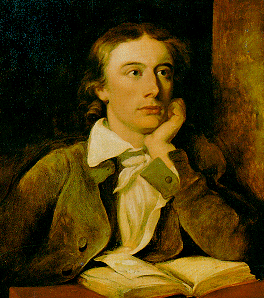
John Keats was born October 31st, 1795 in London, England. Keats struggled a hard life, at age eight his dad died from a fractured skull and seven years later his mom died of tuberculosis. Although he suffered so much at such a young age, he went on to become a surgeon. Not finding his occupation as a doctor enjoyable, he decided to quit and begin a new career as a poet. His sister and close friend were not in agreement with this and thought that his idea of becoming a writer was foolish and silly - he did not let this stop him. He went on to create some of his famous pieces such as St. Agnes Eve, When I Have Fears, To Homer, and many more. He was one of the key figures in the Romantic movement and spent a lot of time writing about topics that had conflicting themes such as life/death, mortal/ immortal, and separation/connection. Sadly, on February 23rd, 1821, at age 25, John Keats died of tuberculosis -- the same disease that his mother died of. Although his life was short, he made a huge impact in the world of poetry.
When I Have Fears
When I have fears that I may cease to be
Before my pen has gleaned my teeming brain,
Before high-piled books, charact'ry
Hold like rich garners the full-ripened grain;
When I behold, upon the night's starred face,
Huge cloudy symbols of a high romance,
And think that I may never live to trace
Their shadows, with the magic hand of chance;
That I shall never look upon thee more,
Never have relish in the faery power
Of unreflecting love! -- then on the shore
Of the wide world I stand alone, and think
Till Love and Fame to nothingness do sink
Subscribe to:
Posts (Atom)